Why I Live with a 3D Printer
France doesn’t really have the equivalent of Japan’s “100-yen shops,” and in general, everyday items tend to be much more expensive.
When I started thinking, “I want to make my life more convenient, and a little more stylish,” one idea suddenly came to mind: “Why not buy a 3D printer?”
Living in France, I’ve noticed that the idea of “disposable” consumption, which is so common in Japan, doesn’t seem to apply in quite the same way. People often use the same things for an impressively long time, taking care of them and repairing them when necessary. They buy something good and continue living with it, maintaining it along the way.
I wanted to adopt some of that mindset myself. At the same time, I also liked the idea that owning a 3D printer could become my own small counterpoint to today’s culture of mass production and mass consumption.
That said, I still haven’t completely overcome my hesitation about using plastic.
The printer I welcomed into my home was the Bambu Lab A1, which is often recommended for beginners.
What surprised me most when I started using it was the sheer quality of the prints. It requires relatively little adjustment and produces remarkably clean results. The main thing I quickly learned, however, was just how important thorough ventilation is while printing.
For modeling, I experiment with different tools depending on the project, including Blender, Tinkercad, and Shapr3D.
My First Print: Solving a Problem of Life Abroad... Sort Of
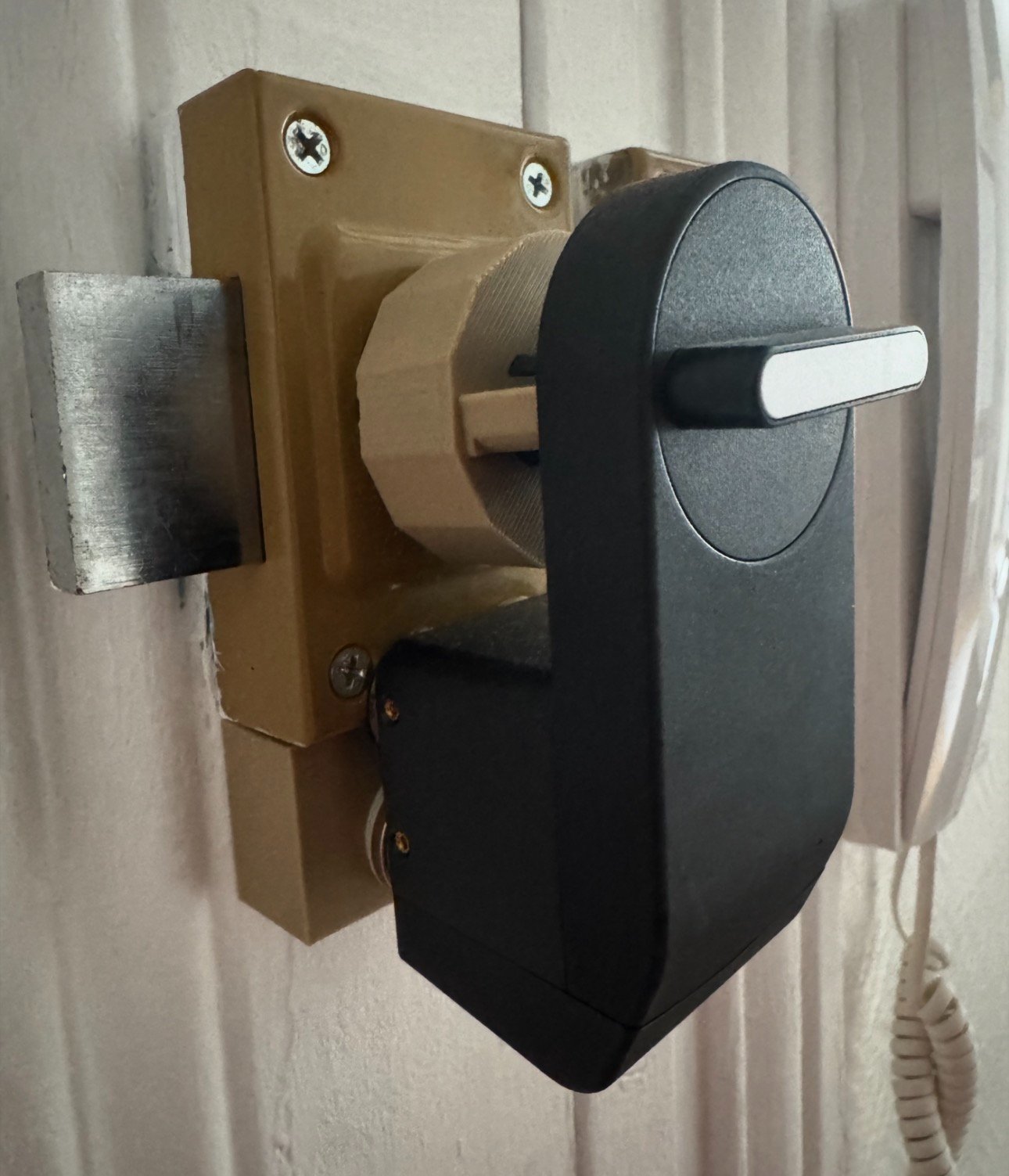
My very first project was a custom attachment for a smart lock installed on my front door, a system that unlocks using facial recognition.
Door handles and thumb turns on products sold abroad are often different from those in Japan, so the device I had bought simply wouldn’t fit my door. I had almost given up on using it.
Thanks to the 3D printer, however, that problem was solved surprisingly quickly.
Or at least, that’s the elegant version of the story.
The part in the photo was actually the result of my very first print — and also my very first failed print.
A few things went wrong during the printing process, leaving it with a slightly rough, unmistakably “I messed this up” appearance.
At first, I considered printing it again. But once I installed it, I discovered that it worked surprisingly well.
It doesn’t look perfect, but it does its job perfectly.
So I thought, “Well, if it works, that’s good enough!” and left it exactly as it was. It is still in active service today, faithfully protecting the entrance to my home.
That first failure taught me a lot. These days, when I model something, I think mainly about beauty, practicality, and cost.
How should I bevel the edges?
How should I design the structure so that it remains strong?
How can I orient the model so that it prints cleanly without support material?
At the beginning, I spent a huge amount of time making mistakes and experimenting through trial and error.
Now, however, I try to keep three principles in mind: don’t overdo it, make life better, and make efficient use of what I already have.
Rather than relying only on ready-made products, I can now update my daily life with my own hands — and with a little help from the data generated by my mistakes.
In the calm rhythm of life in France, my 3D printer has gradually become something I can no longer imagine living without: an essential tool for everyday life.